

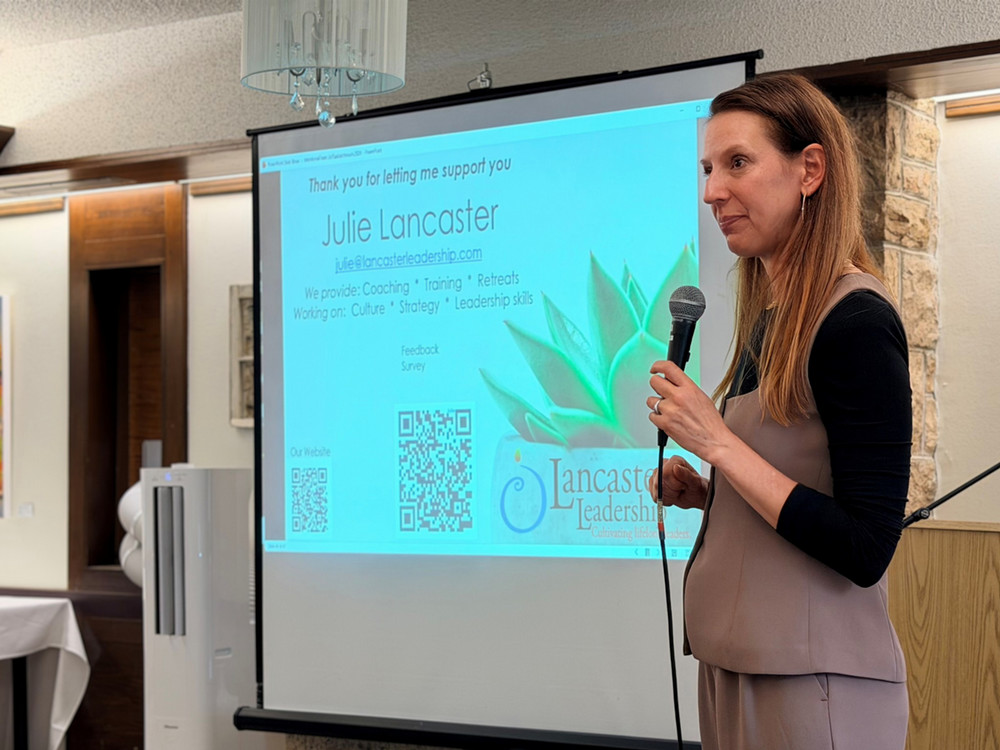
Professional development day highlights culture of innovation, growth and community
Faculty and staff of the College of Dentistry recently gathered for a professional development day focused on leadership, workplace culture and organizational success, led by leadership development expert Julie Lancaster.
By Duane KripThe University of Saskatchewan (USask) College of Dentistry brought faculty and staff together for a professional development day focused on leadership, workplace culture and organizational success, led by leadership development expert Julie Lancaster.
Drawing on her experience working with organizations and educational institutions across North America, Lancaster challenged participants to think beyond traditional measures of success and focus on what today's employees need most to thrive: Purpose, Growth and Community.
A people-first approach to leadership
At the centre of Lancaster's work is the belief that organizations perform better when they create environments where employees feel connected to meaningful work, have opportunities to develop and experience a strong sense of belonging.
Purpose
Employees want to understand how their daily work contributes to a larger mission. Lancaster emphasized that meaningful work is a powerful driver of motivation, engagement and long-term satisfaction.
Growth
Modern employees seek continuous learning, mentorship and opportunities to expand their skills. Rather than relying solely on annual performance reviews, Lancaster advocates for ongoing coaching and development conversations.
Community
Trust, psychological safety and strong relationships are essential for high-performing teams. Organizations that intentionally build connection and recognition, she said, create cultures where people want to stay and contribute.
What stood out about the College of Dentistry
While Lancaster discussed leadership principles throughout the day, she said one of the most striking aspects of her visit was the culture she observed within the College of Dentistry.
“Innovation is a good word around here,” she said. “What I'm hearing is that there's a lot of growth, challenging the status quo and trying to be leaders in the field. And people are on board with that.”
Having worked with many organizations, Lancaster noted that resistance to change is often one of the biggest barriers to progress. At the College of Dentistry, she sensed something different.
“People were really interested in learning, growing and connecting,” she said. “That's not something I take for granted when I walk into a room.”
She described the college as a place where curiosity and professional development appear to be valued across the organization, creating conditions that make innovation possible.
Why openness to learning matters
Lancaster said organizations cannot successfully pursue ambitious goals if their culture resists new ideas.
“If you don't have a culture that's willing to be curious and develop skills and learn, it's like pushing rope uphill,” she said. “Resistance to change ultimately affects whether organizations can achieve their projects and goals.”
For universities and professional schools facing rapid change in education, health care and research, she said a willingness to learn is not simply beneficial, it is essential.
A culture where people feel heard
When asked what distinguishes the College of Dentistry from other dental schools and organizations she has worked with, Lancaster pointed to the college's culture of inclusion and accessibility.
“The hierarchy—I didn't feel it here,” she said. “Of course it exists, but participants commented that they felt listened to and that their voice was important. That's not what I normally hear. That's unique here.”
In fields where traditional hierarchies can sometimes shape workplace dynamics, Lancaster said the sense that people's opinions matter is a significant strength.
The importance of giving feedback
Among the many ideas discussed during the professional development day, Lancaster said she hopes participants will remember one message in particular: to communicate constructive feedback and the bravery to communicate to other what you appreciate about them.
“Especially when things are hard, when we can reach toward what we appreciate about another person and tell them, that's what creates cohesion and engagement,” she said.
She connected that message directly to the three elements employees seek today: Purpose, Growth and Community.
“People like it here,” she said. “I really want people to lean into that.”
More than the technical art of dentistry
For prospective faculty, staff, students and community partners, Lancaster offered a clear assessment of what makes the College of Dentistry distinctive.
“If someone only wants to practice the technical art of dentistry, this may not be the place,” she said. “But if they're looking for a community where collaboration matters and there's a genuine passion for serving students, they should come here because it's not just lip service—it's truly in action.”
Building on what is already working
As the day concluded, Lancaster encouraged participants to begin any future planning by recognizing existing strengths.
“Get clear on what's going well,” she said. “If we want to set goals, we first want to start with what's working well, what's possible, and then explore ideas we haven't tried before.”
For Lancaster, a healthy organization is one where people feel safe enough to be creative, share new ideas and work together toward a common purpose.
“When there's a culture where people are comfortable enough to be creative and share new ideas, that's a real measure of a successful team—a healthy, happy team.”
The June professional development day offered faculty and staff an opportunity not only to learn new leadership strategies, but also to reflect on the culture that continues to shape the College of Dentistry's growth, innovation and sense of community.